Pyrolysis vs. Incineration: Why the Technology is a Better Advanced Waste Solution?
- lee784287
- 1月29日
- 讀畢需時 3 分鐘
The global waste crisis demands innovative solutions that go beyond landfills. For decades, incineration has been the dominant technology for reducing waste volume and recovering energy. However, a newer, more sophisticated thermal process—pyrolysis—is emerging as a fundamentally superior alternative for managing complex modern waste streams. While both involve heat, their core mechanisms, environmental outputs, and economic potentials differ drastically. Here’s why pyrolysis represents the next evolutionary step in waste treatment technology.
The Fundamental Difference: Oxygen is Key
To understand the superiority of pyrolysis, we must start with basic chemistry.
Incineration is a process of oxidation. Waste is burned in the presence of excess air (oxygen) at very high temperatures (850°C – 1200°C). This combustion converts waste directly into heat, flue gases (largely CO2 and water vapor), and a solid residue (bottom ash). The primary goal is volume reduction and energy recovery via steam turbines.
Pyrolysis is a process of thermal decomposition in the absence of oxygen. Waste is heated in a sealed, oxygen-free environment at moderate temperatures (typically 400°C – 800°C). In this "anaerobic" setting, materials do not burn; instead, they chemically break down into their constituent parts. This process yields three valuable product streams: syngas (a combustible fuel gas), bio-oil (a liquid fuel/chemical feedstock), and biochar (a solid carbon-rich material).
This single distinction—the presence or absence of oxygen—creates a cascade of advantages for pyrolysis.
Environmental & Climate Impact: A Clear Winner
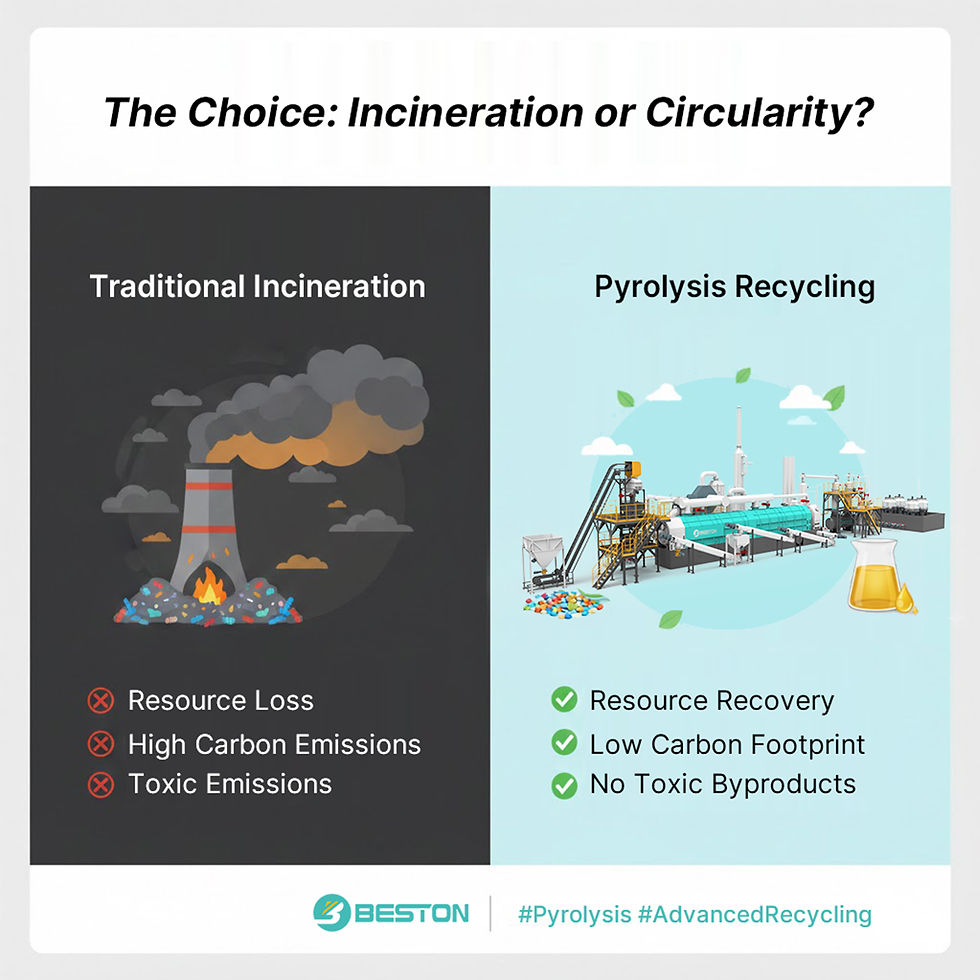
Emissions and Air Pollution: Incineration, despite advanced scrubbers, inevitably produces flue gases that require extensive and expensive cleaning to remove dioxins, furans, acid gases, and heavy metals. Pyrolysis, operating without oxygen, generates a much smaller volume of gas. The syngas can be cleaned and then used to power the process itself, creating a more closed-loop system with significantly lower air emissions.
Carbon Footprint & Resource Recovery: Incineration treats waste as a single-use fuel, releasing most of the carbon as CO2 directly into the atmosphere. Pyrolysis, however, is a resource-recovery technology.
The biochar produced is a stable form of carbon that can be sequestered in soils for centuries, effectively acting as a carbon sink. This gives pyrolysis a potential carbon-negative profile when processing biomass.
The bio-oil and cleaned syngas are alternative energy carriers that can displace fossil fuels, further reducing net emissions.
Waste Hierarchy Alignment: Pyrolysis excels at handling complex, contaminated waste that cannot be mechanically recycled—think mixed plastics, tires, or electronic scrap. It extracts value from these materials, whereas incineration merely destroys them. This places pyrolysis higher on the waste hierarchy, closer to "recycling" than "recovery."
Economic & Output Advantages: Beyond Just Heat
Incineration produces one primary product: heat for electricity generation. Its economic viability often depends on high "tipping fees" (charges for accepting waste) and energy subsidies.
Pyrolysis creates a flexible product portfolio with higher market potential:
Bio-oil: Can be refined into advanced biofuels or used as a chemical feedstock for industry.
Syngas: Used for process heat, electricity generation, or upgraded to renewable natural gas.
Biochar: A high-value product with markets in agriculture (soil amendment), industry (as activated carbon or in metallurgy), and environmental remediation.
This product flexibility allows pyrolysis machine to adapt to market demands, creating a more resilient business model.
The Incineration Niche and the Pyrolysis Promise
It’s fair to acknowledge that modern, state-of-the-art incineration (now often called "Energy-from-Waste" or EfW) has a role. It is a well-understood, large-scale technology effective for treating residual municipal solid waste after extensive recycling, especially in dense urban areas where landfill space is nonexistent.
However, pyrolysis offers a more sustainable and circular pathway forward. It is particularly advantageous for:
Plastic Waste: Converting non-recyclable plastics into liquid fuels or new chemical feedstocks, addressing the plastic pollution crisis.
Biomass and Agricultural Waste: Producing renewable energy and biochar for carbon-smart agriculture.
Hazardous and Industrial Waste: Safely breaking down complex molecules in a controlled environment.
Conclusion: A Step Toward a Circular Economy
The choice between pyrolysis and incineration is not merely technical; it's philosophical. Incineration represents the end of the line—a linear "take-make-dispose" model with energy recovery. Pyrolysis, in contrast, is a bridge to a circular economy. It treats "waste" as a misplaced resource, deconstructing it into valuable building blocks for new fuels, materials, and products while concurrently sequestering carbon.
While no single technology is a silver bullet, pyrolysis offers a cleaner, more resource-efficient, and economically versatile solution for our most challenging waste streams. As we move beyond the era of burning, embracing advanced thermal conversion technologies like pyrolysis is crucial for building a sustainable, low-carbon future. The machine isn't just about disposing of waste; it's about unlocking its hidden value.


留言